Liner Notes
The door that stays open
The song begins in a hallway. One room holds the life the speaker has built: a table set, a porch light kept on, hands reaching for a sleeve in the morning, voices that need something before sunrise. Another room holds a wild thing that was shut away years ago and left there long enough to stop trusting promises. The distance between those rooms is only a few steps, but the song makes that hallway feel like an entire moral landscape.
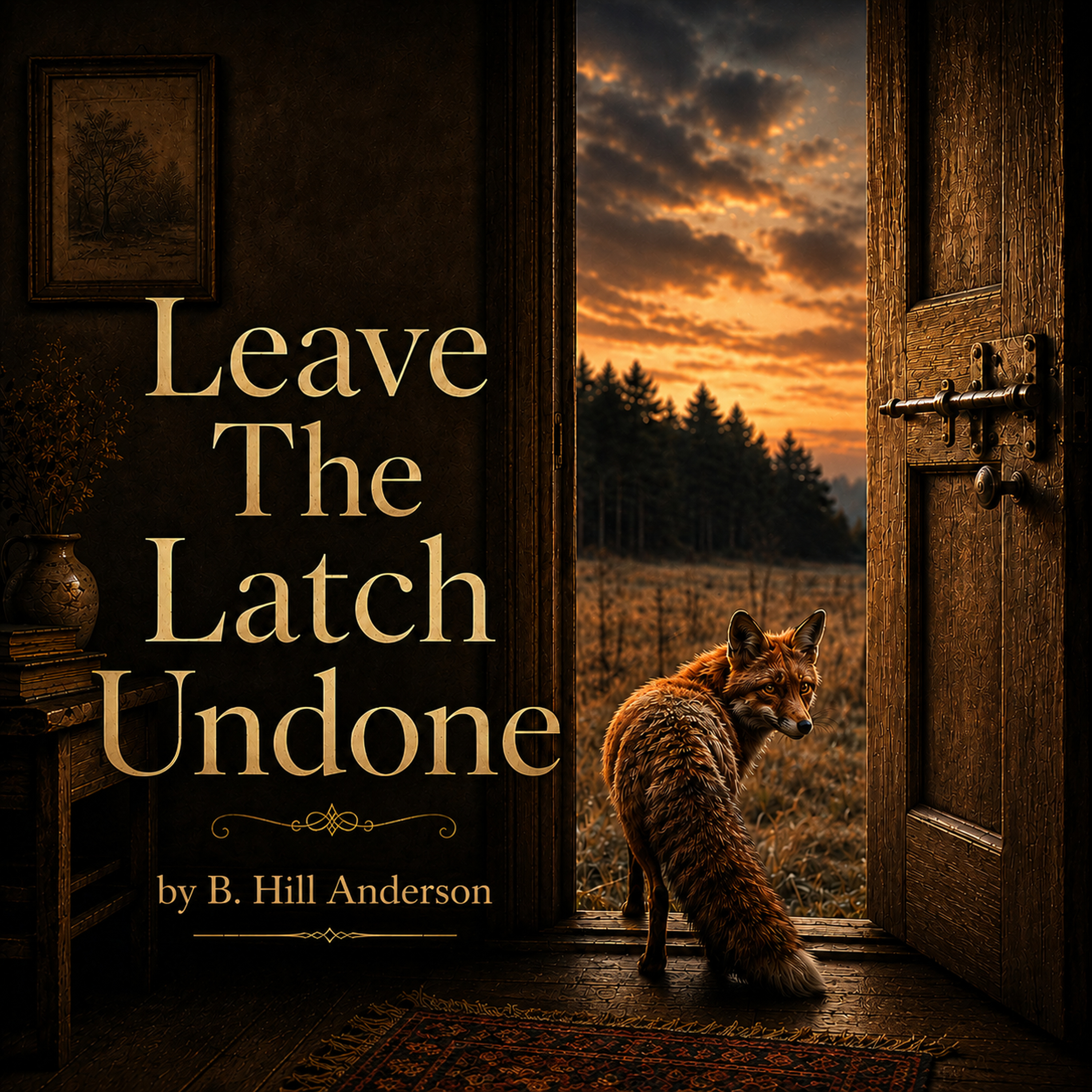
“Leave The Latch Undone” could have been written as an escape song. Its images invite that possibility: a fox, an open field, cold miles beyond the house, a door leading toward trees. But the lyric refuses the simple opposition between freedom and domestic life. The speaker does not describe the family as a trap or the home as a mistake. “I love it. God knows I love all of it” is not a qualification added to soften the conflict. It is the conflict. The life inside the house is real, chosen, and deeply loved. So is the part of the self that can smell the field through the glass.
That double truth gives the fox its force. The animal is not merely appetite, youth, creativity, or freedom. The lyric does not reduce it to one symbolic meaning. It is a part of the speaker that was once alive enough to be feared, then confined in the name of safety. Years later, it is still breathing, but it has been worn down by neglect. The detail “worn down to the ribs” prevents the fox from becoming a romantic emblem of wilderness. This is not a magnificent creature waiting for one dramatic act of liberation. It is a damaged creature that has learned the speaker’s pattern.
The chorus is built from that pattern. “One of these nights” announces a future action. “Not tonight” withdraws it. The speaker stands close enough to witness the fox stop believing, then repeats the same promise anyway. The final rhyme turns the failure inward: “I keep saying I’ll let it out. / All I ever do is let it down.” The line works because the disappointment is not abstract. Each delay teaches the animal something. A latch becomes a record of credibility.
Verse two makes the easy answer impossible. The house contains attachment, labor, tenderness, and obligation. The speaker is not choosing between a false life and a true one. The warm rooms are not counterfeit. The desire for “one cold mile of nobody’s land” is equally real, but it remains a desire rather than a plan. The song allows restlessness to exist without treating restlessness as a command. It also allows love to remain love without using love as an argument for continued self-erasure.
The bridge changes the relationship between the two rooms. The speaker realizes that the wild thing was not the enemy of the life down the hall. It was the part that “taught me how to love the rest.” The effort to keep the two lives safely apart has damaged the source from which the speaker’s tenderness may have grown. That recognition does not produce a dramatic departure. The lyric is careful here: the speaker opens the door, does not run, does not choose, and leaves the whole house standing. Nothing loved has to be destroyed for the neglected self to be acknowledged.
Even then, the fox does not come. This is the song’s most important restraint. A lesser ending might have rewarded the speaker immediately: the animal crosses the threshold, the house and field are reconciled, the speaker becomes whole. “Leave The Latch Undone” refuses that reward. Trust cannot be restored by the same person who broke it simply announcing a better intention. The open door is necessary, but it does not erase the years behind it.
The final chorus therefore abandons the language of control. There is no push toward the trees and no call back inside. The speaker stops deciding where the fox should go and changes only what remains within reach: the latch, the light, the closed door, the impulse to look away. The open hand is not bait. It is an offer without a deadline. The speaker’s task becomes holding still long enough for the fox to discover whether the new condition is real.
That posture makes Grace one of the song’s governing ideas. Grace here is not absolution and it is not a guaranteed return. It is room made for a damaged part of the self without demanding that it perform recovery on command. Home also changes meaning. At the beginning, the house is divided into the life that counts and the room that must remain closed. By the end, home becomes a place that might hold both attachment and wildness, provided neither is forced to disappear for the other to survive.
Within the Collection, the closest relative is “It Just Don’t Feel Like Mine.” That song stands inside a good life and names the estrangement that remains after the choice to settle. “Leave The Latch Undone” enters the same pressure from another angle. It does not watch the lost self pass on the road. It finds that self inside the house and changes the architecture around it. The two works share Identity and Home, but they do not offer the same response. One admits the divide. The other begins the slower work of making the divide less absolute.
As the eighth work, the song also closes the Collection’s first expansion without pretending that anything has been completed. “The Long Argument” ends in public life with the instruction to hand unfinished work forward. This song returns to a private hallway and reaches a similar conclusion at a smaller scale. Repair begins by staying present to what cannot be fixed in one gesture. The final image is not the fox running free. It is the fox watching, the speaker waiting, and a door that is no longer being closed.
The last line matters because it names the only promise the speaker can keep immediately: “I don’t look away.” The fox may cross the threshold later. It may remain where it is. The song leaves that future open. For now, attention replaces postponement. The latch stays undone.