Liner Notes
What the house does not answer
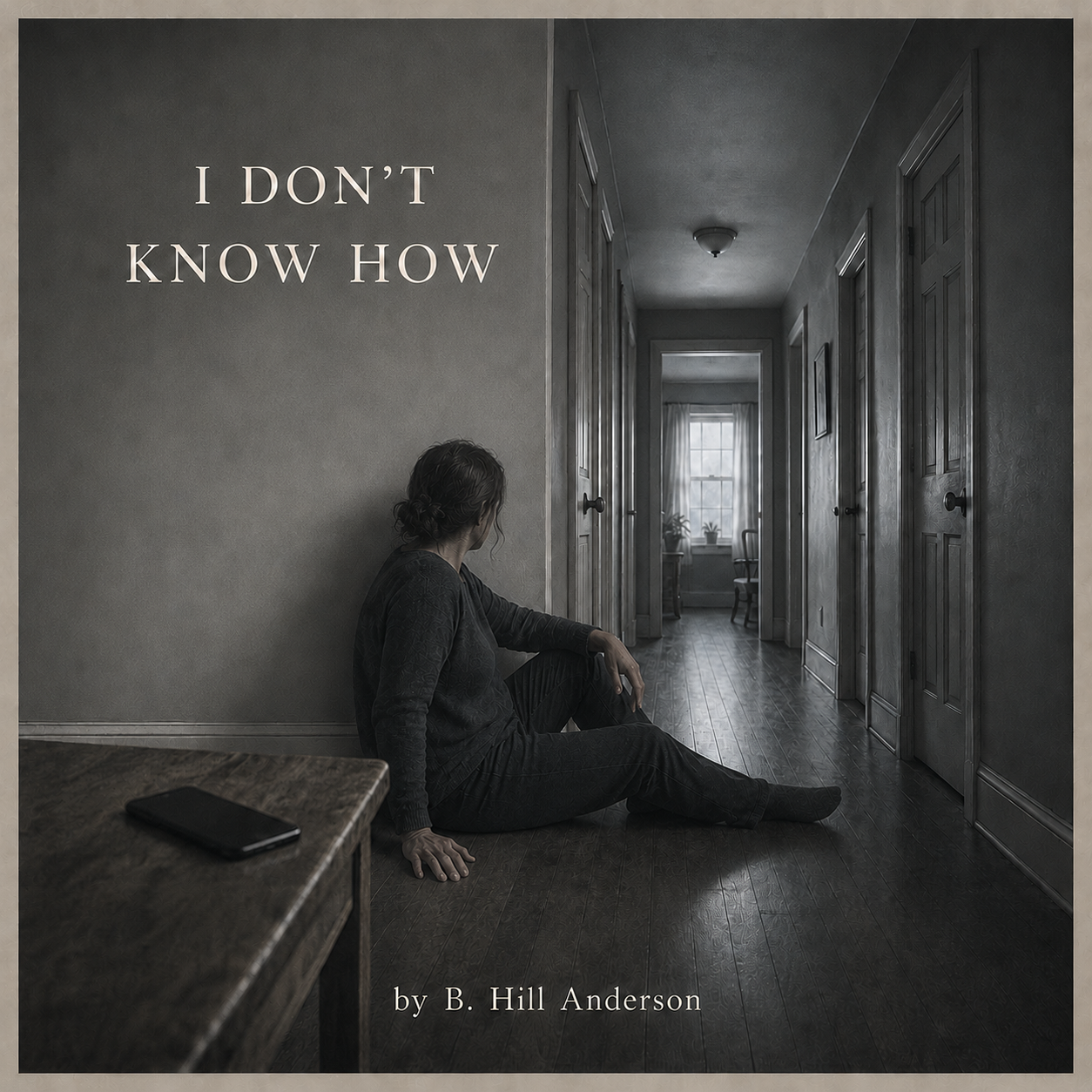
The song begins after the ordinary day has ended and before the next one has made any demands. At four in the morning, the house is quiet enough for one person to hear what cannot be settled during waking hours. Nothing has happened that the lyric is willing to name as a crisis. No door has slammed. No one is leaving. The people down the hall are asleep. The pressure comes from the fact that love and responsibility remain fully present while certainty does not.
That distinction keeps the scene from becoming melodrama. The cold floor, the dark room, the phone on the table, and the first light beyond the glass are ordinary things. Their stillness makes room for a less visible burden: something the speaker cannot carry and cannot set down. The song never defines that burden. It may concern a decision already made, a decision still coming, or the accumulated knowledge that every available choice will touch other lives. The lyric protects that openness because the exact problem matters less than the condition it creates.
The sleeping household gives that condition moral weight. The speaker is not alone in the larger sense. She is surrounded by people she loves, people who count on her to know which way to go. Yet their nearness does not answer the question. It may even make the question harder. Love increases the cost of error. It can make disclosure feel necessary and interruption feel selfish at the same time. The closed doors hold both intimacy and distance: everyone is nearby, and the uncertainty is still hers to carry for the moment.
The chorus is careful about what the speaker admits. “I don’t know how” is placed between two refusals: not “I can’t,” and not “I won’t.” The line does not surrender agency, and it does not pretend that willingness is the same as knowledge. It names a practical and moral uncertainty. A person may intend to act, may accept that action is required, and still lack a reliable way to know which action will protect what matters. Repetition does not solve the problem. It makes the admission more exact.
Verse two turns the pressure toward the past. The speaker has made choices and cannot take them back. That fact removes one of the easier fantasies available in the middle of uncertainty: the belief that enough thought can restore a clean beginning. The question is no longer how to avoid consequence. Consequence is already present. “Am I helping, am I hurting?” is painful because both may be true, and because the people affected are not abstractions. They are asleep down the hall.
The phone offers another kind of temptation. Every voice is sure. Every voice can say what comes next. The song does not ridicule advice or claim that other people have nothing to offer. It notices a limit. Advice can be confident because the adviser does not have to live inside the full web of relationships that will receive the decision. Turning the phone face down is not a declaration of independence. It is a recognition that borrowed certainty cannot carry consequences on the speaker’s behalf.
What follows is one of the quietest actions in the lyric: she listens to the house and lets them sleep. That act can be heard as care. It can also be heard as delay. The song refuses to choose between those readings. Protecting another person’s rest may be merciful, especially when nothing can be clarified at four in the morning. But silence can also become a way of protecting oneself from a conversation that belongs to the household. The lyric stays inside that unresolved difference between discretion and concealment.
The bridge brings morning without revelation. Light begins to show beyond the glass, but clarity does not arrive with it. This matters because songs often use dawn as proof that darkness has passed or that an answer has been earned. Here, morning is only morning. Time moves. The house remains quiet. The speaker waits for something to make the choice clear, and nothing does. The world does not provide a sign simply because the need for one feels urgent.
The final chorus therefore changes the song without resolving its question. The speaker says the admission again and then goes anyway. The last line should not be mistaken for a guarantee of courage, wisdom, or a good outcome. It does not tell us where she goes, what she decides, or whether she wakes anyone before leaving the room. It marks a narrower turn: uncertainty is no longer being treated as a condition that must end before movement can begin.
That turn gives Doubt its place among the song’s three governing ideas. Doubt here is not indecision for its own sake and not an argument against commitment. It is the honest limit of what the speaker knows. Love supplies the stake, not the answer. Home supplies the setting, but the house is more than scenery. It is the living arrangement of dependence, privacy, care, silence, and consequence within which the choice must be made.
Within the Collection, the closest relative is “Leave The Latch Undone.” Both songs stand in a hallway while loved people sleep nearby. Yet their motions differ. That song changes the conditions of return by opening a door and refusing to force what happens next. This one cannot even identify the right door. It asks what responsibility looks like when no gesture can first be proved correct. The relationship is close enough to illuminate both works, but not so close that one supplies the other’s answer.
The ending returns us to the house rather than carrying us beyond it. We have heard no argument, confession, or explanation offered to the sleeping people. We only know that the speaker has listened to their quiet, admitted what she does not know, and moved. The song leaves the moral account open. It trusts that uncertainty can remain real without becoming paralysis, and that love can remain real without being turned into false certainty. Morning comes. Nothing becomes clear. She goes anyway.