THE SWIMMER — John Cheever
Cheever turns a prosperous suburban landscape into a passage through denial, time, and estrangement. Beside this song, the story makes the familiar route home feel less secure with every return.
A mid-life reckoning with the good life, the wild self left behind, and the cost of belonging.
Watch
Watch directly on YouTube. The final lyrics below provide the text transcript.
Listen
Playback does not begin automatically.
Lyrics
Some kid bought my truck, drives it past every night
Windows down, one arm out, chasing the light
He don't know what I traded, he don't know what it cost
Half of me settled, half of me lost
I lift up my hand but he's already gone
The porch light clicks. I go back in alone
I traded the fire for a porch light on
For a ring, for a roof, for a place to belong
And I don't miss the burning. Well, that's a lie
Some nights I do. Then I let it go by
I'd do it again. Every time. Every time
I built a good life. It just don't feel like mine
Inside there's a woman who married me calm
Took the wild out my hands, put a ring in my palm
She's home in this town and she don't want for more
She don't ask what I'm watching the highway for
And loving her's easy. That ain't the divide
It's the kid in that truck still alive here inside
I traded the fire for a porch light on
For a ring, for a roof, for a place to belong
And I don't miss the burning. Well, that's a lie
Some nights I do. Then I let it go by
I'd do it again. Every time. Every time
I built a good life. It just don't feel like mine
Nobody tells you the air up that high gets thin
That you can have the whole sky and still not fit in
So I stepped off the height and I brought it all down
And the quiet I bought is the loudest sound
I traded the fire for a porch light on
For a ring, for a roof, for a place to belong
And I don't miss the burning. Well, that's a lie
Some nights I do. Then I let it go by
I'd do it again. I'd come down again
I built a good life. It just don't feel like mine
Listen Closely
“I built a good life. It just don’t feel like mine.”
Liner Notes
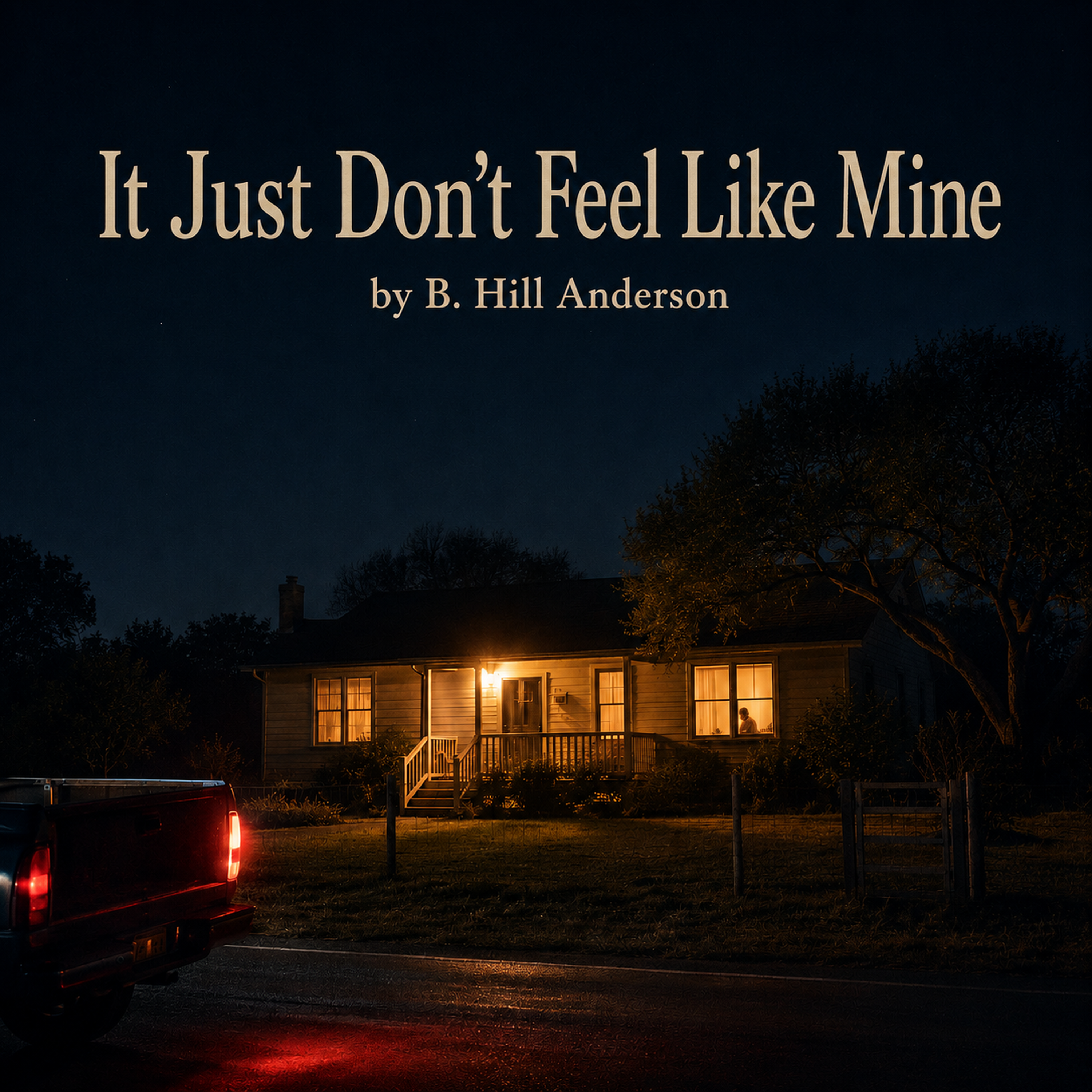
The song begins with a small sight that has become impossible for the speaker to ignore. A younger man drives past the house in a truck the speaker once owned, windows down and one arm outside, moving through the evening as if the road still belongs to him. The speaker raises a hand, but the truck is already gone. Then the porch light clicks and he goes back inside. Nothing dramatic has happened. That is precisely why the scene carries so much pressure. The life outside the window is not a fantasy of escape. It is a former possession moving past the life he chose.
The truck works because it is concrete before it becomes symbolic. It has been sold. Someone else drives it. The new owner does not know what the speaker traded, what the trade cost, or why a passing vehicle can divide one person into the half that settled and the half that still feels lost. The song never needs to explain where the truck once went or what happened inside it. Motion is enough. The young driver occupies a freedom the speaker remembers through posture: windows down, arm out, chasing the light.
Against that motion, the chorus places a porch light, a ring, a roof, and a place to belong. These are not false goods. The speaker does not discover that domestic life was a mistake or that love trapped him. The second verse supplies the necessary guardrail: loving his wife is easy, and she is not the divide. That line protects the song from a familiar and weaker story in which marriage becomes the convenient cause of a man’s estrangement from himself. The conflict remains where it belongs. He chose the life. He would choose it again. He still cannot make every part of himself feel at home inside it.
That distinction gives the title its force. “I built a good life” is not sarcasm. The speaker means it. The life is stable, loving, and recognizable as success. “It just don’t feel like mine” does not cancel the first sentence; it makes the sentence harder. Gratitude and estrangement occupy the same line. The song asks whether a person can honor a choice without pretending the choice preserved every former possibility.
The chorus’s most important move arrives in the correction: “And I don’t miss the burning. Well, that’s a lie.” The speaker briefly reaches for the tidy version of adulthood, the version in which the wild years were simply outgrown and stability resolved the argument. He cannot keep the sentence intact. The admission that follows is modest rather than theatrical. Some nights he misses it. Then he lets it go by. The song does not turn restlessness into a command to leave. It lets desire pass like the truck, visible and unrecovered.
Verse two makes the interior life as concrete as the road. A woman is inside the house. She married him calm. The ring appears again, now not merely as a sign of belonging but as something placed into the hands that once carried more motion. The phrasing is tender and uneasy at once. She did not take a life away from him; she became part of the life he chose. Yet he keeps watching the highway. The younger self is not literally in the truck. He is “still alive here inside,” a presence that the speaker neither releases nor kills off with a lesson.
The bridge widens the image without naming a profession or a biography. The speaker recalls the thin air of being up high, the whole sky available and the self still unable to fit. Height can be heard as ambition, achievement, velocity, or the life organized around ascent. What matters is the action that follows: he stepped down and brought it all down. The quiet was purchased. The bargain was deliberate. Yet the quiet becomes “the loudest sound,” not because the choice was wrong, but because the abandoned self is easiest to hear after the noise is gone.
The final chorus changes one line and therefore changes the whole song. “I’d do it again” becomes “I’d come down again.” The speaker does not seek an alternate ending. He confirms the descent, the marriage, the roof, and the porch light. The loss remains real even after the choice is reaffirmed. That is the song’s restraint. It refuses both fantasies available to it: that the old fire was worthless, or that recovering it would repair everything.
Within the Collection, the song belongs beside “I Never Saw Jerusalem,” but as a contrast rather than a repetition. Jerusalem follows a man who keeps turning delay into explanation and remains seated before a visible possibility. Here, the speaker did move. He chose, built, and stayed. His reckoning comes after action rather than in place of it. Both songs ask what a person becomes through repeated choices, but this one gives the settled life full moral weight. The ache is not failure to arrive. It is arriving and discovering that belonging does not automatically produce self-possession.
The porch light remains on at the end. The truck keeps moving. The speaker goes back inside. The song does not ask him to choose again; it asks him to tell the truth about what the first choice cost. A good life can be real. Love can be real. The former self can remain real too. The title holds all three without turning any of them into the enemy.
In Conversation
Cheever turns a prosperous suburban landscape into a passage through denial, time, and estrangement. Beside this song, the story makes the familiar route home feel less secure with every return.
Williams follows an outwardly modest life shaped by work, marriage, disappointment, and private devotion. It offers a useful counter-pressure: a settled life may become fully one’s own without ever becoming grand.
Tolstoy’s novella gives the harshest version of the question, following a man whose correct and successful life becomes inwardly unrecognizable. The song stops well before that verdict, but it shares the demand for honest self-recognition.
Worth Your Time
Novel
Yates writes about a marriage pressed by ambition, disappointment, performance, and the fear that an ordinary life has become a false one. The novel is darker and more corrosive than this song, and that difference matters. “It Just Don’t Feel Like Mine” refuses to make the wife or the marriage the source of the speaker’s estrangement; he loves her, owns the choice, and would come down again. Read the novel as a counter-pressure: a study of what happens when restlessness is turned outward and the shared life becomes the defendant.
Credits and Rights
Licensing and professional inquiries: contact@bhillanderson.com. Burton Hill Anderson LLC controls both the composition and the master, so synchronization and master use license from one party. Rights identifiers are held in the private Collection record and sent to licensees on request.
Accessibility
Square cover art showing a modest house at night across a wet rural road. Warm windows and a porch light contrast with a dark blue sky; a black pickup exits at left with red taillights reflecting on the pavement. The title It Just Don’t Feel Like Mine and the byline by B. Hill Anderson appear in cream lettering above the house.
The official-audio video uses the approved cover artwork and opens on YouTube. The website does not autoplay the video.
The on-page audio player presents the complete recording without autoplay. Standard browser controls provide play, pause, volume, and timeline access.
The final lyrics published above provide the text transcript for the recording.
Continue Reading
This song names the estrangement inside a life deliberately chosen. Leave The Latch Undone takes the same pressure into the house and asks what repair looks like when neither departure nor denial will do.
Follow works concerned with belonging, shelter, return, and the gap between having a place and feeling fully at home within it.
No published Journal entry currently follows this question. A future essay may examine the life a person chooses and the self that choice requires them to set down.
The porch light stays on. The road keeps passing.