Liner Notes
What remains under the paint
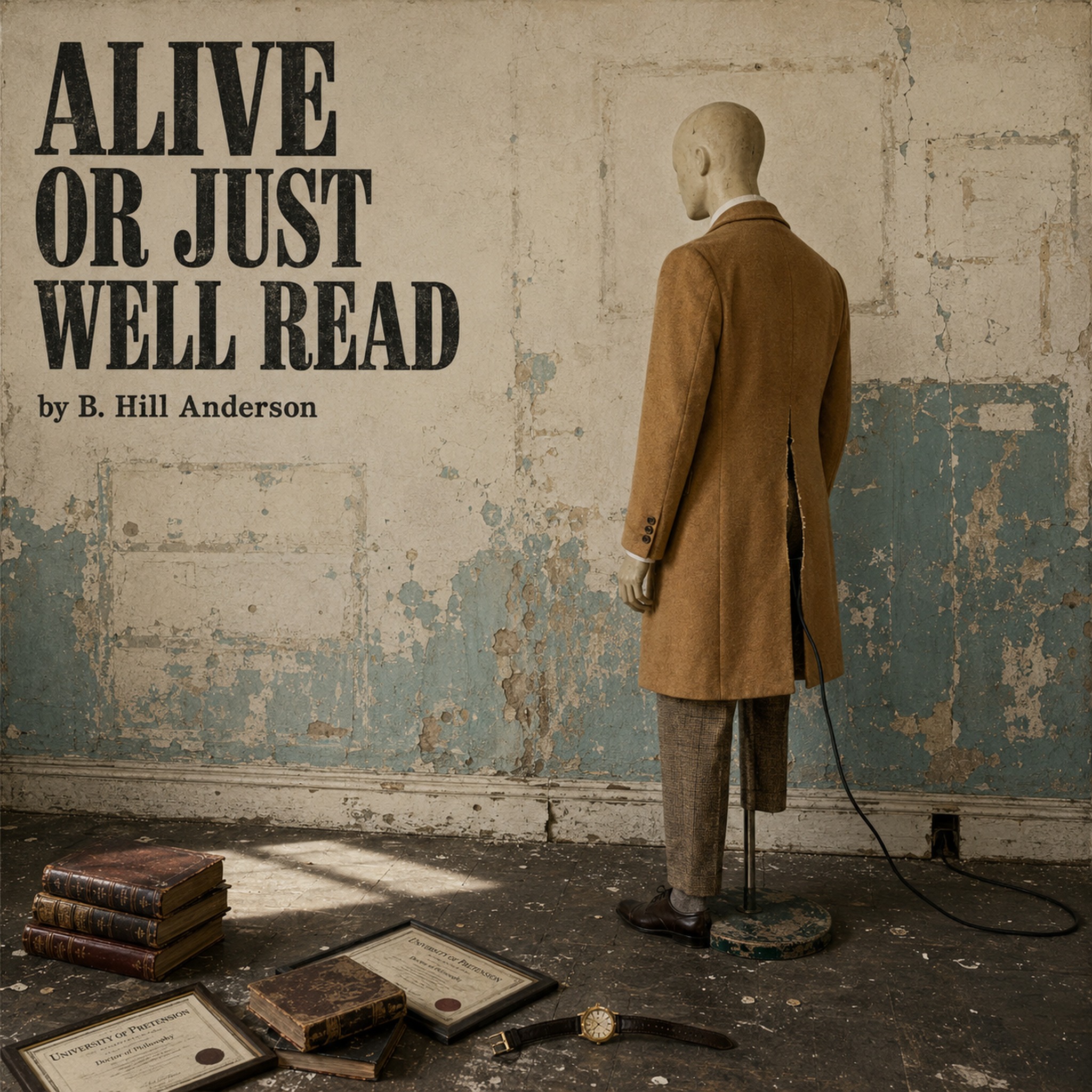
A wall of books can mean many things: work, pleasure, memory, aspiration, inheritance. In “Alive or Just Well-Read,” it first appears as evidence. The books, framed courses, practiced quotations, new coat, watch, and front door all help the speaker present a coherent account of himself. Each item says that a life has been considered and completed. The unease comes from his knowledge that the display may be doing more living than he is.
The song begins with a blunt admission: the books have not been read. That detail makes the room unstable. Objects that seemed to testify to curiosity now testify to arrangement. The courses behind glass carry a similar ambiguity. Learning may have happened, but the framed proof has become part of the set. The speaker can quote a line without knowing its source and can keep an answer short enough to avoid the question that might expose the distance between possession and understanding.
The chorus refuses the usual promise that another layer will repair what is underneath. “You are who you are, you ain’t who you ain’t” sounds almost like reassurance until the next line removes the paint and finds nothing behind it. The repeated phrasing does not offer a hidden, intact self waiting to be uncovered. It asks what happens when performance has continued so long that the speaker cannot confidently name the person the performance was meant to protect.
The second verse returns to borrowed language, connecting this song directly to “Cut & Paste.” A birthday message arrives from somebody else’s writing and is sent to an old friend. The screen is tipped away, not because the message is cruel, but because its source would reveal the wire running out of the speaker. The image turns dependence into stagecraft. What looks spontaneous has cables. What looks intimate has been prepared elsewhere.
By the third verse, the arrangement has expanded into a whole photographed life. The coat, watch, house, and pose belong together as a public surface. Yet the lyric calls all of it rented or on loan. That language does not merely condemn material possessions. It asks whether ownership can become another form of citation: a way of pointing toward the kind of person one hopes others will infer. When the straight question comes, the speaker becomes a dial tone. The system can transmit an image but cannot answer.
The bridge begins taking the set apart. Books, frames, credentials, and house are removed until the speaker is imagined standing in rubble. Even then, the song does not guarantee discovery. The stripping away only makes the question unavoidable. This is the middle movement of The Confession Trilogy because it enlarges the first song’s anxiety without resolving it. Borrowed words have become a borrowed life, and exposure now threatens not one awkward silence but the architecture of identity.
The title’s question remains unanswered. Reading can deepen a life, and the song does not confuse ignorance with authenticity. Its suspicion is directed at the conversion of knowledge into display and at the possibility that description has substituted for experience. To be well-read is not the opposite of being alive. The danger lies in using one as proof of the other. The last line leaves the speaker in the rubble with no certificate capable of answering for him, and no clean assurance that the person beneath the display will immediately know how to live.