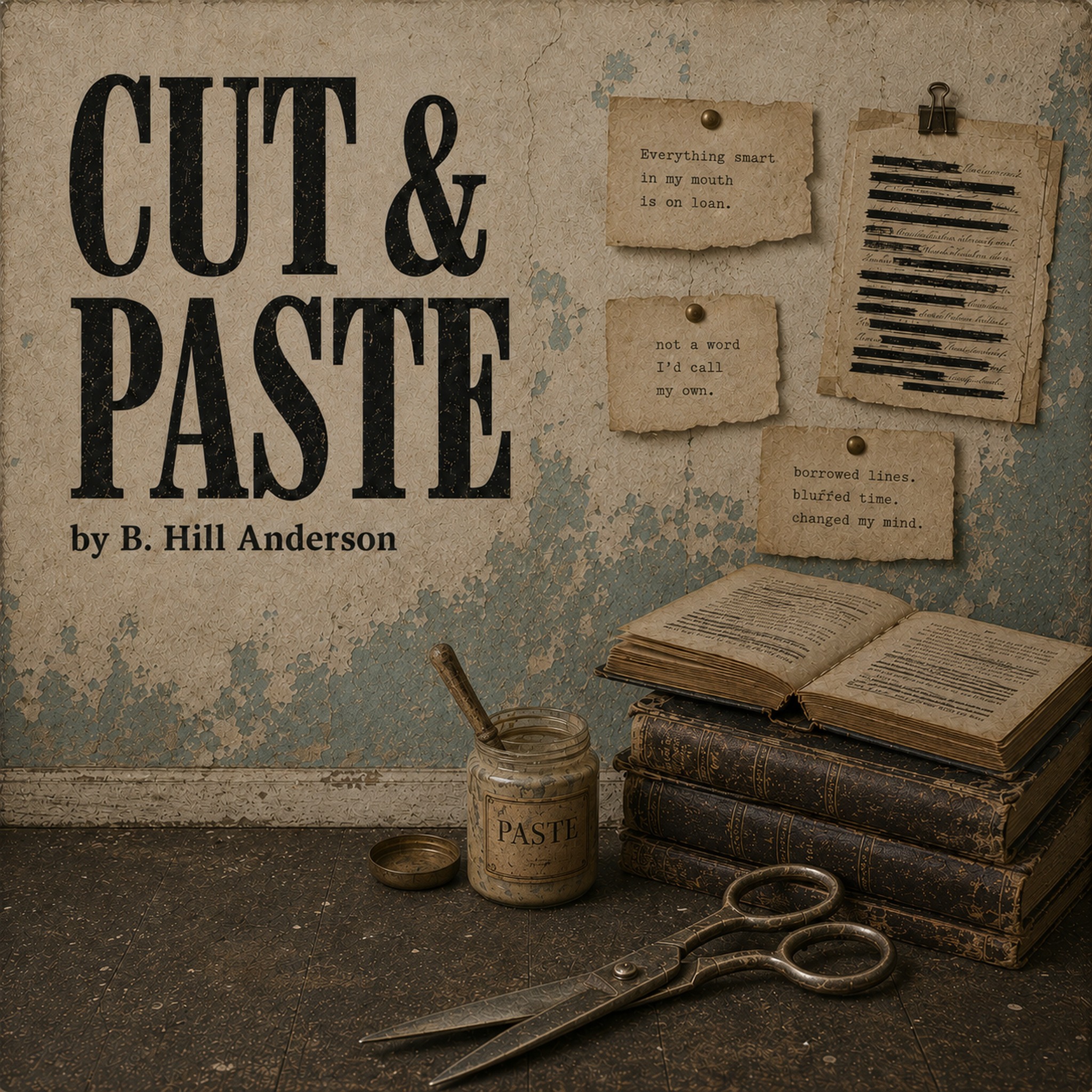
Square cover art for Cut & Paste showing a worn room with books, papers, and tools arranged around the title and byline by B. Hill Anderson.

Part One of The Confession Trilogy

Cut & Paste

A confession about borrowed language and the fear of being left without a line.

Forthcoming August 22, 2026 · 03:00 · Rock / Singer-Songwriter

Watch

Official audio on YouTube

Watch directly on YouTube. The final lyrics below provide the text transcript.

Listen

Play the recording

Listen to the complete recording here. Playback does not begin automatically.

Lyrics

Cut & Paste

The room wants an answer I never planned,
and I'm bluffing it out with a losing hand.
I built what I am out of everybody's lines,
and I'm lost when I can't find one in time.

So I cut, and I paste, and I make it through,
say it like I mean it, like I always knew.
Everything smart in my mouth is on loan,
and I can't find a line in here I'd call my own.

Paperback open, the good parts underlined,
by dinner I'll say them like they came from my mind.
I'm the book in my hand and the voice in my ear,
convinced by the last thing that sounded sincere.

So I cut, and I paste, and I make it through,
say it like I mean it, like I always knew.
Everything smart in my mouth is on loan,
and I can't find a line in here I'd call my own.

They got stuck and turned to me, sure I would know,
but there wasn't a line I could borrow or quote.
I opened my mouth and the silence fell out.
I stood there wearing nothing but doubt.

So I cut, and I paste, and I make it through,
say it like I mean it, like I always knew.
Everything smart in my mouth is on loan,
and I can't find a line in here I'd call my own.
No, not a word in here I'd call my own.

Listen Closely

“I opened my mouth and the silence fell out.”

Liner Notes

When the borrowed line runs out

The room wants an answer before the speaker has one. That is the small emergency at the center of “Cut & Paste”: not a public scandal or an exposed lie, but the ordinary pressure of being expected to sound ready. He has learned to meet that pressure with material gathered elsewhere. A phrase from a book, a voice still in his ear, somebody else’s confidence carried into the room as if it were his own. The method works often enough to become a self.

The title names a familiar mechanical action, but the song is interested in what happens when that action becomes a way of living. Cutting and pasting can be efficient, useful, even intelligent. Every mind is made partly from what it has heard and read. The problem is not influence. The problem begins when the speaker can no longer tell the difference between influence and concealment, between learning from another voice and using that voice to avoid the risk of speaking.

The chorus keeps the confession plain. He makes it through. That phrase matters because it explains the bargain. Borrowed language is not presented as vanity alone; it is also a survival technique. Rooms reward fluency. Preparedness can look like authority, and hesitation can be mistaken for ignorance. The speaker has discovered that sounding as though he “always knew” protects him from the moment when somebody might see uncertainty arrive.

The second verse moves from the room to the paperback. Underlining is usually an act of attention, but here the marked passage is being prepared for social use. By dinner, the borrowed thought will have lost its visible source. The lyric does not accuse reading itself. It notices how easily reading can become costume: the book in the hand, the line delivered at the proper moment, the recent voice mistaken for conviction. What entered as another person’s thought leaves as evidence of a self the speaker is trying to maintain.

Then the system fails. Someone turns to him with confidence, and no usable line appears. The bridge strips away the song’s busier verbal motion until the only thing left is silence. “I opened my mouth and the silence fell out” makes absence physical. He is not merely unable to answer a question. He is left standing inside the gap between the person others believe they are consulting and the person who cannot locate a word he recognizes as his own.

Within The Confession Trilogy, this is the first and narrowest exposure. “Alive or Just Well-Read” will widen the concern from speech to identity, asking whether the same method has assembled the speaker’s books, credentials, possessions, and public shape. “No More Auditions” will carry the performance into marriage, where the practiced self turns out not to have been required. But “Cut & Paste” does not know those later rooms yet. It remains with the first failure of the machinery.

The final chorus changes almost nothing, which is why its last line lands. The speaker has named the practice but has not escaped it. Recognition does not immediately produce an original voice. The song leaves him searching through the language in his own mouth and finding every sentence tagged by somebody else. What comes next is not the triumphant discovery of authenticity. It is the quieter and more difficult possibility that silence may have to be endured before an unborrowed word can be spoken.
In Conversation

Three works nearby

“Self-Reliance” — Ralph Waldo Emerson

Emerson’s argument against conformity supplies a severe counterpoint: an insistence that a person trust the thought arising within rather than borrow the authority of another voice.

Read “Self-Reliance” at Project Gutenberg

“Tradition and the Individual Talent” — T. S. Eliot

Eliot complicates the fantasy of a voice made from nothing. The essay treats originality as a relationship with inherited language, which sharpens the song’s distinction between influence and hiding.

Read the essay at Poetry Foundation

Worth Your Time

“Self-Reliance” — Ralph Waldo Emerson

Essay

Beside this song, Emerson is worth reading less as a prescription for confidence than as an uncompromising test. His demand for nonconformity can feel almost impossible once the speaker’s dependence on borrowed language is visible. That severity helps clarify what “Cut & Paste” refuses to fake: naming imitation is not the same as possessing an original self. The essay and the song disagree productively about how available such a self may be.

Read “Self-Reliance”

Credits and Rights

The factual record

Written by B. Hill Anderson.
Artist: B. Hill Anderson.
Published by Burton Hill Anderson LLC.
PRO: ASCAP.

Written and artistically directed by B. Hill Anderson. AI-generated vocals, instrumentation, arrangement, production, and audio rendering created with Suno v5.5 under a commercial license.

Licensing and professional inquiries: contact@bhillanderson.com. Burton Hill Anderson LLC controls both the composition and the master, so synchronization and master use license from one party. Rights identifiers are held in the private Collection record and sent to licensees on request.

© 2026 Burton Hill Anderson LLC. All rights reserved.

Accessibility

Text alternatives and listening context

Cover art

Square cover art for Cut & Paste showing a worn room with books, papers, and tools arranged around the title and byline by B. Hill Anderson.

Video

The linked video is an official-audio presentation using the cover artwork. No rapidly flashing imagery is used.

Audio and transcript

The on-site player does not begin automatically. The complete lyrics above serve as the transcript of the sung words.

Continue Reading

Paths through the Collection

Explore Identity

Follow this governing idea through other works in the Collection.

The Journal

Read independent notes and essays that widen the Collection without decoding the songs.