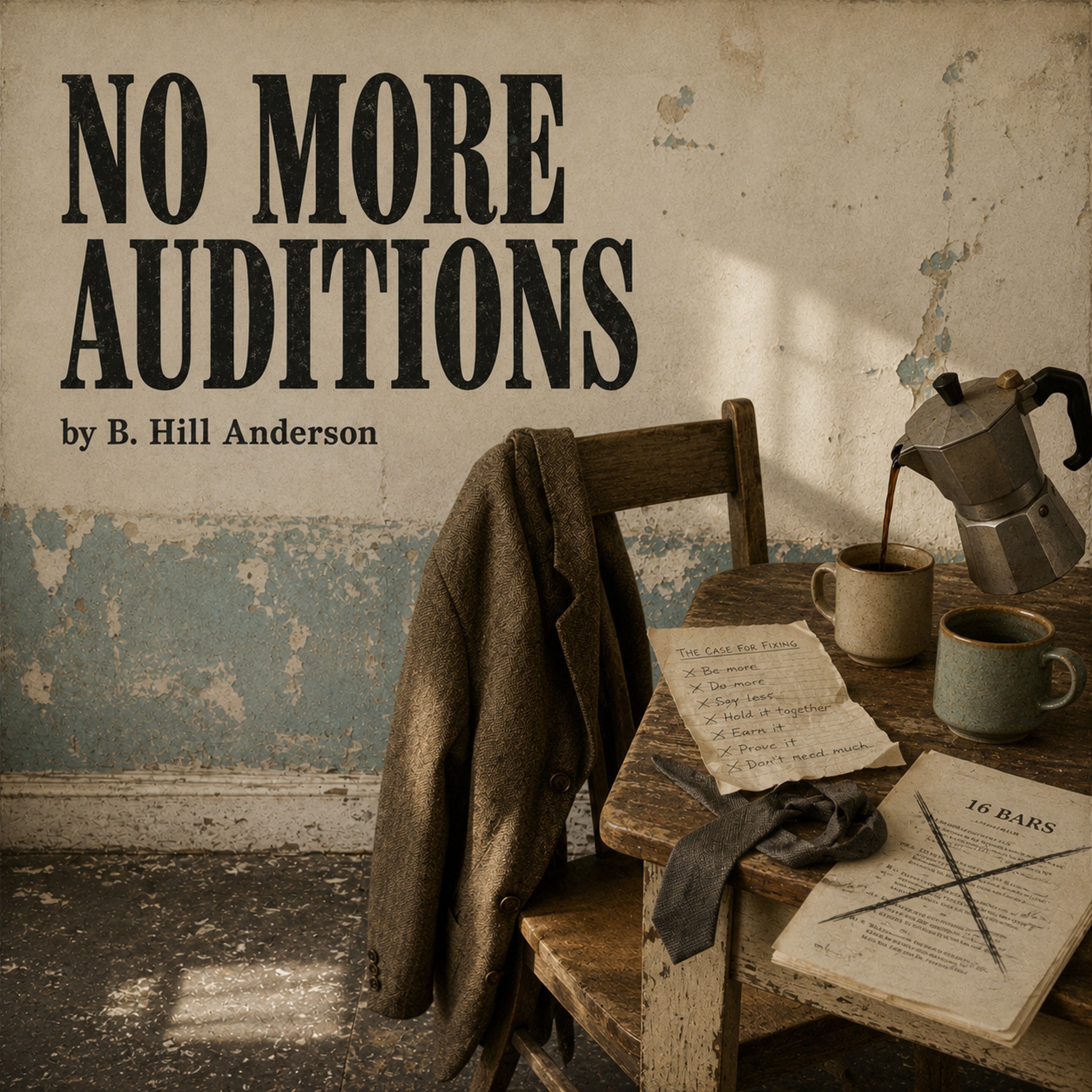
Square cover art for No More Auditions showing a quiet domestic interior and a solitary figure beneath the title and byline by B. Hill Anderson.

Part Three of The Confession Trilogy

No More Auditions

A marriage song about the practiced self and the difficult work of accepting unearned regard.

Forthcoming August 22, 2026 · 04:04 · Rock / Singer-Songwriter

Watch

Official audio on YouTube

Watch directly on YouTube. The final lyrics below provide the text transcript.

Listen

Play the recording

Listen to the complete recording here. Playback does not begin automatically.

Lyrics

No More Auditions

I’m in the kitchen making one more case,
lining up my reasons, searching your face.
You touch my arm and pour another cup.
I lose my place. Somehow that’s enough.

No more auditions, no more lines to say,
no more waking beside you with a part to play.
You never needed the man I rehearsed to be.
I’m learning to believe the way you look at me.

I still wake some mornings with a list inside my head,
what I ought to fix and what I should have said.
Then you smile across the pillow, easy as the sun,
and for half a minute I forget who I’d become.

I don’t know why you love me. I may never understand.
But I’m learning not to question what is resting in your hands.

No more auditions, no more lines to say,
no more waking beside you with a part to play.
You never needed the man I rehearsed to be.
I’m learning to believe the way you look at me.

Some nights I start again, explaining every scar,
why I became the man I was, how I came this far.
You don’t correct the story. You don’t tell me what it means.
You turn out the light and make a little room for me.

No more auditions, no more lines to say.
I wake beside you with no part to play.
You never needed the man I rehearsed to be.
I’m learning to believe the way you look at me.

Listen Closely

“You never needed the man I rehearsed to be.”

Liner Notes

Love after the rehearsal

The final song of The Confession Trilogy begins in a kitchen, where the speaker is making a case. The phrase belongs to courtrooms and arguments, but the setting is domestic: reasons lined up beside a cup of coffee, the beloved’s face searched for a verdict. Before the case can be completed, she touches his arm and pours another cup. He loses his place. The interruption offers no answer to his reasoning, yet something in it is enough.

“No More Auditions” carries the trilogy’s performance language into the most intimate room. In “Cut & Paste,” the speaker borrowed words to survive public expectation. In “Alive or Just Well-Read,” he assembled an identity from books, credentials, possessions, and presentation. Here the rehearsed self appears beside the person who has lived closest to him. He is still explaining, correcting, and preparing even when the relationship has not asked him to earn entry.

The chorus names the hoped-for change, but it does so in the language of learning rather than arrival. “I’m learning to believe” is the governing phrase. The speaker can see that his wife did not need the man he rehearsed to be, yet seeing is not the same as trusting. A lifetime of auditioning does not end because the room is safe. The old part remains available each morning, complete with its list of repairs and missed lines.

That list matters because performance is not presented as theatrical vanity alone. It is also labor: constant review, correction, and anticipation. The speaker wakes already measuring himself against an internal role. Across the pillow, his wife smiles “easy as the sun,” and for half a minute he forgets who he had become. The lyric does not claim that love erases the performed self. It creates brief intervals in which the performance is not directing the scene.

The pre-chorus keeps the song from turning acceptance into proof. He does not know why he is loved and may never understand. The temptation is to question the gift until it can be justified, because justified love can be controlled. Instead, he tries not to interrogate what is resting in her hands. This is where Grace enters the trilogy: not as innocence or rescue, but as regard that arrives before the speaker can establish his worthiness.

The bridge returns at night to the old habit of explanation. He begins again with scars, causes, and the narrative of how he became this man. She does not correct the story or supply its meaning. She turns out the light and makes room. That response is restrained enough to preserve the difficulty. Love does not decode him, absolve every harm, or declare the story finished. It allows him to remain without completing the argument for his presence.

The final chorus changes “waking beside you with a part to play” into “I wake beside you with no part to play.” Grammatically, the change sounds complete. Emotionally, the next line returns to learning. The song understands that a new sentence can be spoken before it is fully inhabited. This is why the trilogy ends here without becoming a cure: the audition may be over in the beloved’s eyes while continuing inside the speaker.

What remains is a possibility rather than a triumph. Borrowed worth has been exposed as unnecessary in one relationship, but the speaker must still practice receiving what cannot be earned by performance. The light goes out. A little room is made. He does not finally explain himself, and the woman beside him does not ask him to. The song leaves him there, learning whether he can stay when no one is waiting for the rehearsed man to appear.
In Conversation

Three works nearby

“Ego Distortion in Terms of True and False Self” — D. W. Winnicott

Winnicott describes the false self not merely as deceit but as a protective organization. That distinction complicates the speaker’s rehearsal by asking what it may once have protected, even after it is no longer needed.

View the chapter at Oxford Academic

ALL ABOUT LOVE — bell hooks

hooks treats love as practice rather than sentiment, placing attention, care, and responsibility beside the song’s small domestic gestures and its refusal to turn love into a verdict.

View All About Love at HarperCollins

“On Marriage” — Kahlil Gibran

Gibran’s brief meditation imagines closeness that preserves room between two people, a useful companion to the bridge’s modest act of making space without explaining the other person.

Read “On Marriage” at Project Gutenberg

Worth Your Time

“Ego Distortion in Terms of True and False Self” — D. W. Winnicott

Psychoanalytic essay

Winnicott is useful beside this song because he resists treating the performed self as simple fraud. A false self may begin as protection and competence before becoming a barrier to feeling real. That account gives weight to the speaker’s difficulty: he is not removing a costume that never mattered, but loosening a structure that helped him survive rooms and relationships. The beloved’s regard does not destroy it. It may create conditions in which it is no longer required.

View the chapter at Oxford Academic

Credits and Rights

The factual record

Written by B. Hill Anderson.
Artist: B. Hill Anderson.
Published by Burton Hill Anderson LLC.
PRO: ASCAP.

Written and artistically directed by B. Hill Anderson. AI-generated vocals, instrumentation, arrangement, production, and audio rendering created with Suno v5.5 under a commercial license.

Licensing and professional inquiries: contact@bhillanderson.com. Burton Hill Anderson LLC controls both the composition and the master, so synchronization and master use license from one party. Rights identifiers are held in the private Collection record and sent to licensees on request.

© 2026 Burton Hill Anderson LLC. All rights reserved.

Accessibility

Text alternatives and listening context

Cover art

Square cover art for No More Auditions showing a quiet domestic interior and a solitary figure beneath the title and byline by B. Hill Anderson.

Video

The linked video is an official-audio presentation using the cover artwork. No rapidly flashing imagery is used.

Audio and transcript

The on-site player does not begin automatically. The complete lyrics above serve as the transcript of the sung words.

Continue Reading

Paths through the Collection

Explore Love

Follow this governing idea through other works in the Collection.

The Journal

Read independent notes and essays that widen the Collection without decoding the songs.