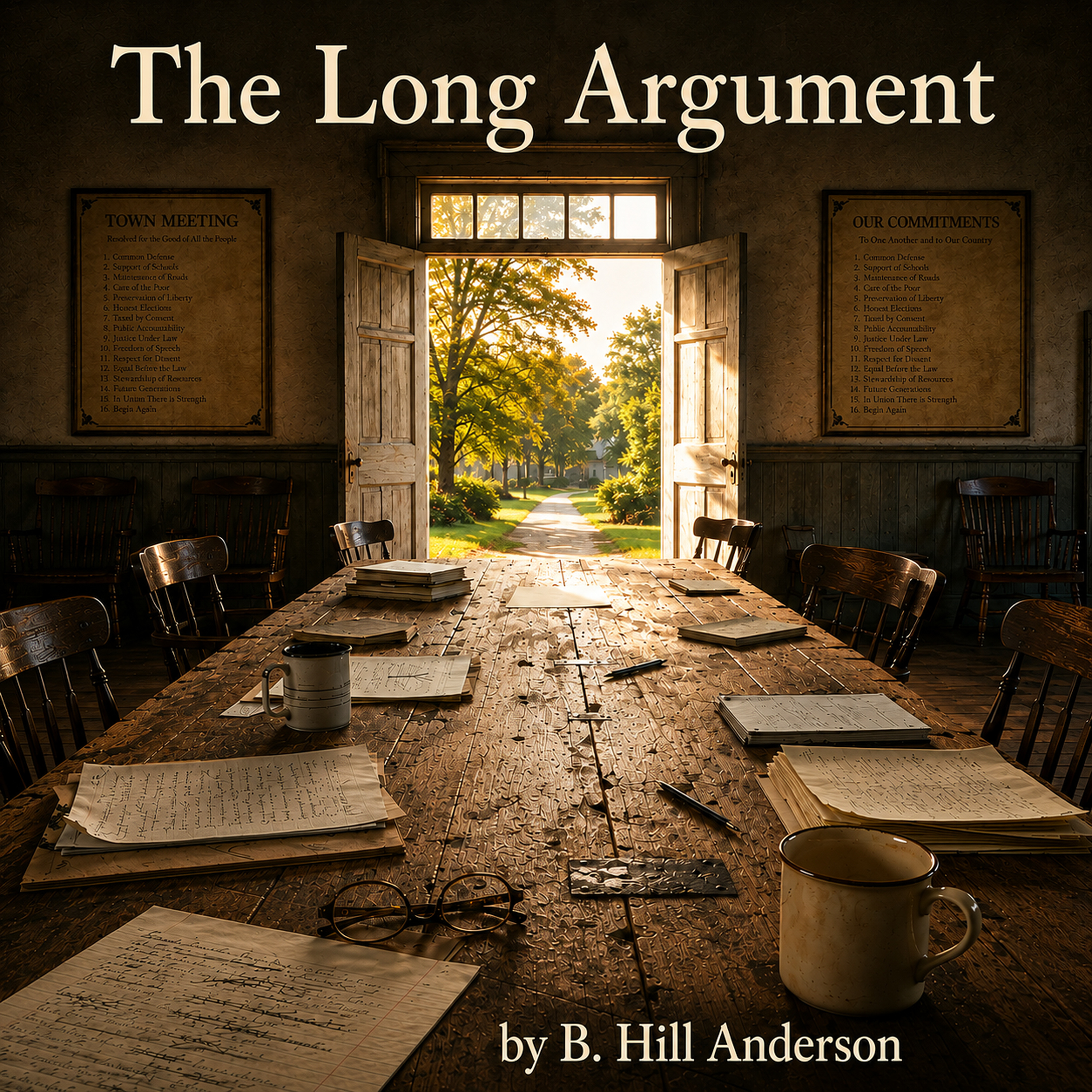
Square cover art showing an empty rustic town meeting hall at golden hour. A long weathered table is covered with handwritten papers, mugs, pens, and eyeglasses, while open double doors frame a sunlit path and trees. The title The Long Argument appears in large cream lettering across the top, with the byline by B. Hill Anderson centered near the bottom.

The Long Argument

A civic song about inherited promise, unfinished work, and the responsibility to keep showing up.

Released June 27, 2026 · 4:03 · Americana / Roots Rock

Watch

Official audio on YouTube

Watch directly on YouTube. The final lyrics below provide the text transcript.

Listen

Play the recording

Listen to the complete recording here. Playback does not begin automatically.

Lyrics

The Long Argument

Nobody’s ever done this before
Put America’s name on a dream and swore
Handed it down still unresolved
To every restless, arguing age

Lord I love this broken, stumbling place
Every scar and every saving grace
We stumble forward, we begin again
Hand it on and start the work again

We took it apart and put it back
Fought over every word and line
We patched the roof and braced the frame
And handed it on down the line

Lord I love this broken, stumbling place
Every scar and every saving grace
We stumble forward, we begin again
Hand it on and start the work again

There’s no winning
There’s only staying in
Every generation antes up
Nobody finishes, they only begin
And hand it on and hand it on

Lord I love this broken, stumbling place
Every scar and every saving grace
We stumble forward, we begin again
Hand it on and start the work again

This isn’t someone else’s fight
This isn’t someone else’s dream
The ones who changed it showed up
And so can you, and so can we

Lord I love this broken, stumbling place
Every scar and every saving grace
You stumble forward, you begin again
Hand it on and start the work again
This is the long argument, the oldest bet
The most important fight that isn’t over yet
We are still becoming, still becoming
Still arguing around the same long table
Hand it on, hand it on
Hand it on

Listen Closely

“There’s no winning.
There’s only staying in.”

Liner Notes

The work no generation finishes

The song begins not with a scene but with a proposition: nobody has ever finished the American experiment. The claim is large, but the lyric does not use it to celebrate novelty or innocence. It places the country inside an inheritance that arrived already unsettled. A dream was named, sworn to, handed down, and argued over before anyone now living entered the room.

That distinction keeps “The Long Argument” from treating democracy as a monument. Monuments suggest that the important work has already been completed. This song is built from verbs instead: took, fought, patched, braced, showed up, handed on. The country it describes is not a finished structure to admire from the lawn. It is a house under continuous repair, with each generation responsible for the condition in which it receives the place and the condition in which it leaves it.

The repair language is deliberately ordinary. Roofs leak. Frames weaken. Words and lines have to be fought over because words become rules, promises, exclusions, and permissions. The lyric does not claim that every repair succeeds. It says that taking the structure apart and putting it back together is part of the inheritance itself. Argument is not evidence that the project has failed. Argument is one of the ways the project remains open to correction.

The chorus supplies the song’s emotional center. “Lord I love this broken, stumbling place” is not a declaration of national purity. It is an attachment that has survived evidence. The scars remain beside the saving grace. The place can be loved without being declared innocent, and its failures can be named without pretending that departure from responsibility is the only honest response.

That posture matters within the Collection. “White Stones Don’t Lie” measures institutional language against irreversible human cost. “The Next Bright Lie” watches grievance and belonging become instruments of manipulation. “The Long Argument” does not answer either warning by asking for trust. It asks for participation. Its civic hope is not confidence that authority will behave well. It is the narrower belief that unfinished institutions can still be contested, repaired, and handed on by people who refuse both worship and abandonment.

The third verse sharpens that belief by refusing the language of victory. “There’s no winning / There’s only staying in” rejects the fantasy that one election, law, movement, leader, or generation can settle the argument permanently. Winning is temporary and often misleading. Staying in means accepting that progress can be partial, reversible, and inherited by people who may understand the work differently. The wager is not that history moves cleanly forward. The wager is that continued participation leaves room for correction.

The line “Every generation antes up” makes that participation costly. An ante is not a guarantee of return. It is what a person puts at risk in order to remain in the game. The song’s use of the image is restrained, but the implication is serious: citizenship requires more than opinion. It requires time, attention, disagreement, compromise, witness, and sometimes sacrifice. Nobody finishes. Everyone enters after others have paid, and everyone leaves work for those who follow.

The bridge moves from inheritance to responsibility. “This isn’t someone else’s fight” strips away the comfort of spectatorship. The song has used “we” throughout, but the bridge makes the collective pronoun accountable. A nation can become an abstraction that allows every individual to blame an equally abstract public. The bridge insists that the people who changed the inherited structure were people who appeared, argued, organized, voted, testified, served, resisted, built, and returned. The lyric does not make those actions interchangeable or equally righteous. It does insist that change has always required presence.

The final chorus then changes “we stumble forward” to “you stumble forward.” The shift is small but important. The song stops speaking only about a collective and places the inheritance in the listener’s hands. The title arrives late, after the chorus has already been heard several times. By then, “the long argument” is not merely a description of political conflict. It has become the name of an unfinished relationship between promise and practice.

The table in the final lines is a better image than a battlefield for what the song wants to preserve. A battlefield imagines an enemy who must be defeated before peace can begin. A table imagines people who remain in relation while disagreeing, though the history of who has been allowed a seat cannot be ignored. The table can be expanded. Its rules can be challenged. The argument can expose hypocrisy as well as protect continuity. The important thing is not civility for its own sake. It is keeping the public space open enough for truth, correction, and participation.

That is why the song’s hope remains modest. It does not promise national redemption. It does not say that every scar becomes grace or that every generation improves on the last. It says the country is still becoming. The phrase allows both possibility and indictment. A thing still becoming has not fulfilled its claim.

The closing instruction is therefore not “believe.” It is “hand it on.” Preserve what deserves preservation. Repair what can be repaired. Name what cannot be defended. Make room for the people who were previously excluded from the table. Leave the argument more honest, and the structure more capable of bearing weight, than it was when it reached you.
In Conversation

Three works nearby

Federalist No. 51 — James Madison

Madison’s essay assumes that disagreement and self-interest cannot be eliminated, so power must be arranged to resist its own concentration. Beside the song, it offers an institutional version of the same refusal to depend on civic innocence.

Read Federalist No. 51 at the Library of Congress

Second Inaugural Address — Abraham Lincoln

Delivered near the end of the Civil War, the address joins moral judgment to humility and refuses an easy triumphal ending. Its closing call to continue the work places repair after catastrophe rather than pretending that victory settles responsibility.

Read the Second Inaugural Address at the National Park Service

“What, to the American Slave, Is Your 4th of July?” — Frederick Douglass

Douglass keeps the national promise under argument by exposing the people excluded from its celebration. The speech is essential counterpressure beside a civic song: inherited ideals matter only when their contradictions can be named without ceremony closing the subject.

Explore the Library of Congress record

Worth Your Time

OUR DECLARATION — Danielle Allen

Book

Allen reads the Declaration of Independence as a public text whose argument about equality belongs to ordinary citizens, not only scholars or officials. Her line-by-line attention is useful beside this song because it treats founding language as an active inheritance rather than a relic. The book does not ask readers to ignore the gap between promise and practice. It asks what becomes possible when people learn to read, argue over, and claim responsibility for the words together.

View the publisher’s page for OUR DECLARATION

Credits and Rights

The factual record

Written by
B. Hill Anderson
Artist
B. Hill Anderson
Production
Written and artistically directed by B. Hill Anderson. AI-generated vocals, instrumentation, arrangement, production, and audio rendering created with Suno v5.5 under a paid commercial license.
Published by
Burton Hill Anderson LLC
PRO
ASCAP
Composition copyright
© 2026 Burton Hill Anderson LLC. All rights reserved.

Licensing and professional inquiries: contact@bhillanderson.com. Burton Hill Anderson LLC controls both the composition and the master, so synchronization and master use license from one party. Rights identifiers are held in the private Collection record and sent to licensees on request.

Accessibility

Text alternatives and listening context

Cover art

Square cover art showing an empty rustic town meeting hall at golden hour. A long weathered table is covered with handwritten papers, mugs, pens, and eyeglasses, while open double doors frame a sunlit path and trees. The title The Long Argument appears in large cream lettering across the top, with the byline by B. Hill Anderson centered near the bottom.

Video

The official-audio presentation accompanies the recording with the approved square cover artwork. Lyrics do not appear onscreen, and the page does not autoplay video.

Audio

The on-page audio player presents the complete recording without autoplay. Standard browser controls provide play, pause, volume, and timeline access.

Transcript

The final lyrics published above provide the text transcript for the official audio.

Continue Reading

Paths through the Collection

Related work

The Next Bright Lie

That song studies the moment public hurt becomes available to manipulation. This one answers from a different posture: remain present, keep judgment, and accept the labor of participation.

Explore by Idea

Work

Follow songs concerned with labor, service, duty, repair, invisible effort, and the responsibility carried through doing.

Journal

Love Is Not a Blindfold

An independent essay on loyalty that remains accountable and refuses to let belonging become silence.

The argument stays open. The work passes on.