Liner Notes
The king who asks nothing
The speaker begins with time, money, and a route. His passport has been stamped at Haifa, and he has three days to himself. He gets on the bus that climbs toward the place he intends to reach. Nothing in the opening makes arrival impossible. The plan is concrete enough to be completed within a day: go up the hill and touch the old wall. The song's failure of arrival will have to come from somewhere other than a missing opportunity.
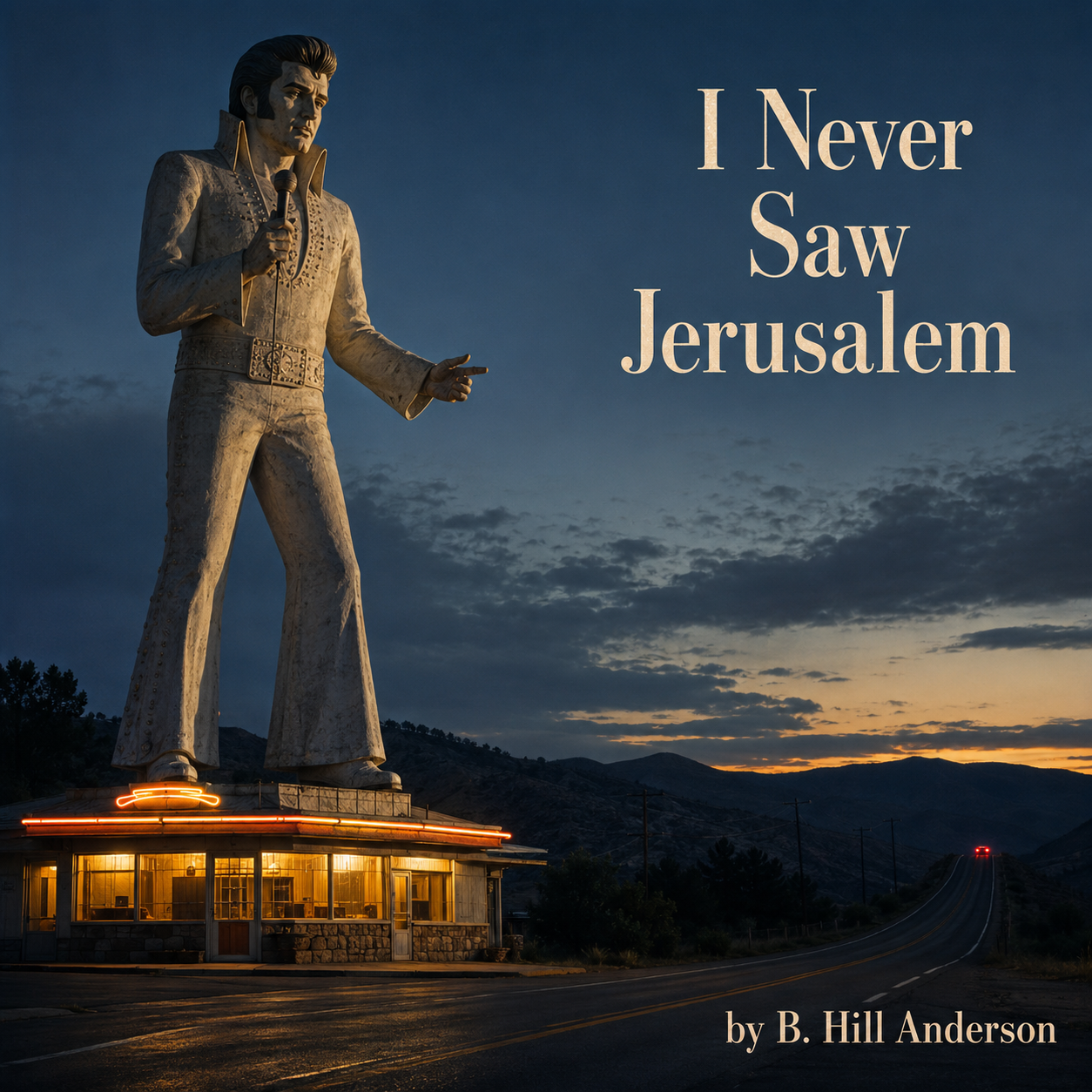
Then a forty-foot Elvis enters the landscape. The roadside figure offers a startling interruption to the imagined journey, a familiar American spectacle on the way to a place invested with a different kind of significance. The speaker takes a stool in its shadow. The image can be funny, but the lyric does not leave it at the level of a travel story. Sitting becomes a choice whose meaning grows harder as the song continues.
The first chorus reports the limit of the trip. The speaker made it that far. At this point, the explanation might still seem recoverable: an afternoon diverted, a plan postponed, an absurd landmark remembered more clearly than a destination. The title supplies the result without yet supplying the reason. Its plainness makes room for the listener to hear disappointment before deciding what kind of disappointment it is.
The next verse gives the other passengers a different action. They return to their seats and the bus moves on. Someone describes how the dome changes in the light. The speaker stays where he can watch the taillights climb. The journey is still occurring within sight; what has stopped is his participation in it. The lyric places movement and stillness in the same scene so the missed possibility remains visible.
The speaker names exhaustion and shame. Those admissions matter because they make the stool more than an emblem of laziness or temptation. The speaker is too tired to follow and too ashamed to pray. The two conditions are related without being made identical. One concerns the strength to move; the other concerns whether an approach feels available to the person he believes himself to be. Neither requires the listener to invent a particular offense.
The bridge brings that inward distance into the open. The speaker could not bring himself to touch the wall. He knew what he had done and what he was, but the song gives no list of deeds with which a listener could confirm or overturn that judgment. The omission keeps the pressure on his relation to himself. An explanation that catalogued his history might let the audience decide his case too quickly and escape the uneasiness of his refusal.
The figure beside the road becomes a king who asks nothing of him. That phrase makes the shelter attractive without pretending it can meet the original need. The stool offers a place to remain without facing a demand, a question, or an imagined judgment. The lyric does not tell us that the destination would actually have condemned him. What matters is that he experiences the familiar spectacle as easier to approach than the place he set out to reach.
That distinction leaves the religious dimension open. Jerusalem is not reduced to a prize that a better person would have earned, and the missed visit is not used to prove that forgiveness has been refused. The barrier described in the bridge belongs to the speaker's inability to make the approach. His account may be honest and still incomplete. The song does not grant him authority to say what would have happened had he stood up.
The final chorus preserves the hills and the seat. The speaker can still see enough to know where he has not gone. Having a good seat sounds almost like an answer until it is heard beside the title. Comfort remains available within the admission of failure. The final repetition does not send him back onto the road, but neither does it make the road disappear. He stays in a place from which the possibility of movement can still be imagined.
Within the Collection, the work sits close to the unfinished offering in Nothing Leaves This Room. Both songs place a person near an action that matters and let a protective space become difficult to leave. Jerusalem gives that space a roadside stool and an extravagant figure overhead. The song's force lies in keeping the image concrete while allowing the confession beneath it to deepen. The listener is left with a man who knows where he meant to go and has begun to say why he did not get there.