Shore Leave — Patriots Point Naval & Maritime Museum
The museum’s archive places liberty inside the ordinary life of sailors, where time ashore offered relief from shipboard pressure and produced the photographs and stories crews carried forward.
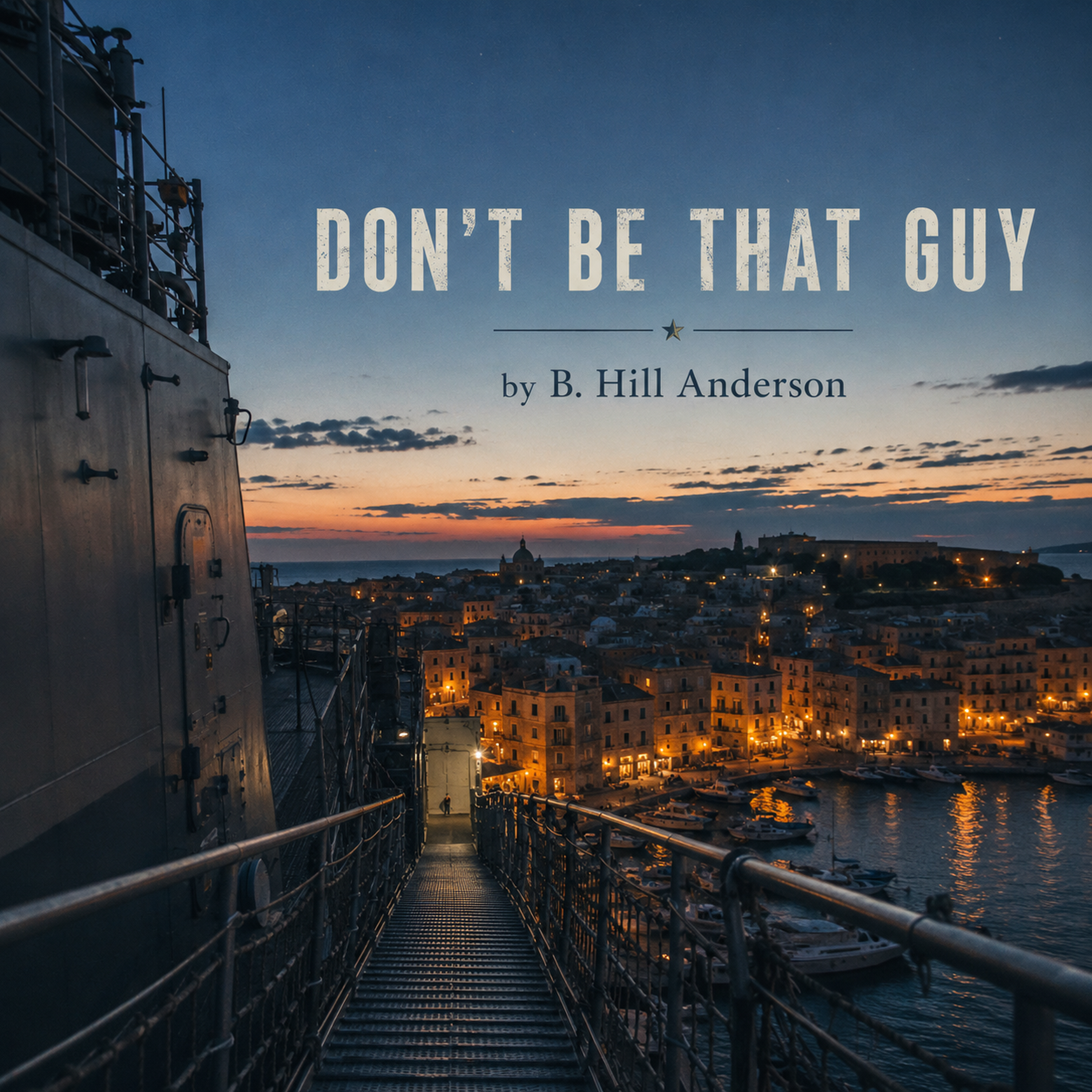
A comic Navy story song about liberty, memory, and the younger self who refuses to stay gone.
Watch
Watch directly on YouTube. The final lyrics below provide the text transcript.
Listen
Playback does not begin automatically.
Lyrics
The Chief called muster with a clipboard and a chart
Said “boys, we’re hitting Naples, want you back here before dark
Stick to your buddy, keep your wallet on your hip
Whatever else you do tonight, don’t embarrass this ship”
He listed every way a sailor blows his liberty pay
Pickpockets and polizia and trains that go astray
And right before he cut us loose he looked us in the eye
Said “the only thing that matters, sailors: don’t be that guy”
Don’t be that guy who slept right through ship’s movement
Don’t be that guy on the front of the local news
Don’t be that guy in a Roman holding cell
Don’t be that guy down to his skivvies and his shoes
We all said “aye aye, Chief,” and we shook his hand goodbye
Then we walked down the brow and we became that guy
Smitty bought a leather jacket two sizes too small
Hernandez tried to wrestle a statue near city hall
I lost a hundred dollars in a card game on a tour boat
And I threw in my dress whites just to keep myself afloat
Reyes took a taxi he was sure was bound for Rome
It dropped him at some nonna’s house in a town she called home
She fed him pasta, called him bambino, sent him on his way
He came back speaking Italian to the Master-at-Arms next day
Don’t be that guy who slept right through ship’s movement
Don’t be that guy on the front of the local news
Don’t be that guy in a Roman holding cell
Don’t be that guy down to his skivvies and his shoes
We all said “aye aye, Chief,” and we shook his hand goodbye
Then we walked down the brow and we became that guy
Now I’ve seen the seven seas and I’ve seen the Chief retire
I’ve seen the new guys come aboard and learn the rules by fire
There’s a hundred foreign ports where I left a little story
And a hundred saner sailors who came home with all the glory
But every time I see a kid in dress blues at the bar
I want to tell him, son, just remember who you are
Then I want to buy him three and toast him with a sigh
’Cause Lord help me, I still miss being that guy
Don’t be that guy who slept right through ship’s movement
Don’t be that guy on the front of the local news
Don’t be that guy in a Roman holding cell
Don’t be that guy down to his skivvies and his shoes
We all said “aye aye, Chief,” and we shook his hand goodbye
Then we walked down the brow and we became that guy
The Chief retired in ’99, the ship’s been sold for scrap
Every time we meet up, boys, we raise a glass and laugh
’Cause we all said “aye aye, Chief,” and we shook his hand goodbye
Then we walked down the brow
And we became that guy
Listen Closely
“Then we walked down the brow and we became that guy.”
Liner Notes
The song begins with a warning everyone already knows will fail. A Chief stands at muster with a clipboard, a chart, and the accumulated knowledge of what sailors can do to themselves during one night ashore. He names the hazards, tells them to stay together, and gives them the only instruction broad enough to cover every possible mistake: do not be that guy. The sailors answer correctly. Then they walk down the brow and become him.
That structure gives “Don’t Be That Guy” its comic engine. The warning is not merely ignored; it becomes a map of the evening. A jacket is bought in the wrong size. A statue is challenged. Dress whites become collateral in a card game. One sailor’s taxi to Rome ends at a stranger’s house, where a nonna feeds him and sends him back toward the ship. The details matter because they are specific enough to feel lived in while remaining larger than any one biography. The incidents belong to the lyric’s fictionalized or composite story world. Their truth is not documentary precision. It is the recognizable logic of liberty, where freedom, youth, money, and distance briefly outrun judgment.
The chorus works as both rule and confession. “Don’t be that guy” is the language of institutional memory, passed from those who have already made the mistakes to those who are about to repeat them. The first four lines name public humiliation: missing movement, appearing on the news, waking in custody, losing everything but shoes. Yet the final two lines move the song from ridicule into fellowship. The sailors do not point at one offender. They become the category together. The phrase stops being an accusation and becomes a form of belonging.
That belonging is not innocent. The Chief’s warnings exist because ships must sail, people must return, and one person’s recklessness can become another person’s burden. The song does not deny responsibility or turn failure into heroism. Its comedy depends on the distance between the sailors’ confident answer and their conduct. But it also understands why the stories survive. The mistakes become communal property. Years later, they are told not because they were wise, but because they hold the texture of a life that discipline alone cannot preserve.
The bridge changes the scale. The speaker has seen more seas, watched the Chief retire, and watched younger sailors arrive to learn the same rules. Time has turned the night in Naples into one story among many. He can now admit that saner sailors came home with the glory. This is not the usual veteran song in which reckless behavior is retroactively made noble. The narrator knows the difference between service and misbehavior. He also knows that maturity does not erase affection for the self who once acted before consequence had fully acquired weight.
The young sailor in dress blues brings that conflict into the present. The older man wants to offer the responsible advice: remember who you are. Then he wants to buy the sailor three drinks. The contradiction is the song’s emotional center. Age gives him the knowledge to warn, but memory gives him no clean desire to prevent every mistake. What he misses is not humiliation, danger, or punishment. He misses the company, the permission of youth, and the version of himself who had not yet learned to turn every decision into a forecast of loss.
The final chorus therefore lands differently from the first. The repeated list still gets a laugh, but “we became that guy” now carries time inside it. The men became foolish sailors for one night, then became older men who kept the story. The title’s “that guy” becomes less a fixed type than a former self, embarrassing and beloved in equal measure.
The outro refuses to leave the song at the bar. The Chief is retired. The ship is gone. The crew’s world survives only in memory and in the gathering where the story is told again. Those details remain inside the lyric rather than being offered as verified history. Editorially, their function is clear: authority ages, machinery disappears, and the people who once stood at muster become the archive.
Within the Collection, “Don’t Be That Guy” opens a different door into service. “White Stones Don’t Lie” stands at a grave and tests the language authority uses after loss. This song stands at the brow before liberty and remembers authority as warning, ritual, and care. One song asks whether loyalty can tell the truth about command. The other asks what becomes of the ordinary disorder that service contains but official remembrance often leaves out. Together they widen the Collection’s account of military life. Service is not only sacrifice or policy. It is also work, time, appetite, embarrassment, and the stories people carry home.
The song ends where such stories usually end: with a raised glass and a line everyone can finish. The laughter does not cancel the cost of growing older. It gives that cost a room, a crew, and a name.
In Conversation
The museum’s archive places liberty inside the ordinary life of sailors, where time ashore offered relief from shipboard pressure and produced the photographs and stories crews carried forward.
O’Brien’s linked stories keep testing how service becomes narrative and how fiction can carry emotional truth without pretending every remembered incident is a literal record.
Ponicsan returns to former sailors years after their youth and lets humor, loyalty, regret, and the changed meaning of service occupy the same room.
Worth Your Time
Novel
Ponicsan follows two Navy lifers ordered to escort a young sailor to prison and gives them one final stretch of freedom before the institution closes around him. The novel belongs beside this song because it understands military comedy as more than comic relief. Drinking, boasting, bad decisions, rank, and improvised fellowship reveal men whose tenderness usually arrives disguised as trouble. Read it for the way a temporary liberty becomes an argument about authority, loyalty, and the stories sailors tell when they cannot change the ending.
Credits and Rights
Licensing and professional inquiries: contact@bhillanderson.com. Burton Hill Anderson LLC controls both the composition and the master, so synchronization and master use license from one party. Rights identifiers are held in the private Collection record and sent to licensees on request.
Accessibility
Square cover art at dusk, looking down a metal gangway from the side of a gray Navy ship toward a lit Mediterranean harbor. The title Don’t Be That Guy appears in large cream letters above the byline by B. Hill Anderson.
The official-audio video uses the approved cover artwork and opens on YouTube. The website does not autoplay the video.
The on-page audio player presents the complete recording without autoplay. Standard browser controls provide play, pause, volume, and timeline access.
The final lyrics published above provide the text transcript for the recording.
Continue Reading
Where this song remembers the disorder and fellowship inside service, White Stones measures the public language used when service ends in irreversible loss.
Follow works concerned with what is retained, reshaped, inherited, and carried forward.
No published Journal entry currently follows this question. A future essay may examine the stories service members tell when danger is no longer the point.
The ship is gone. The story still makes muster.